

Authored by: Captain SA |SA Rainbow News |25th May 2026
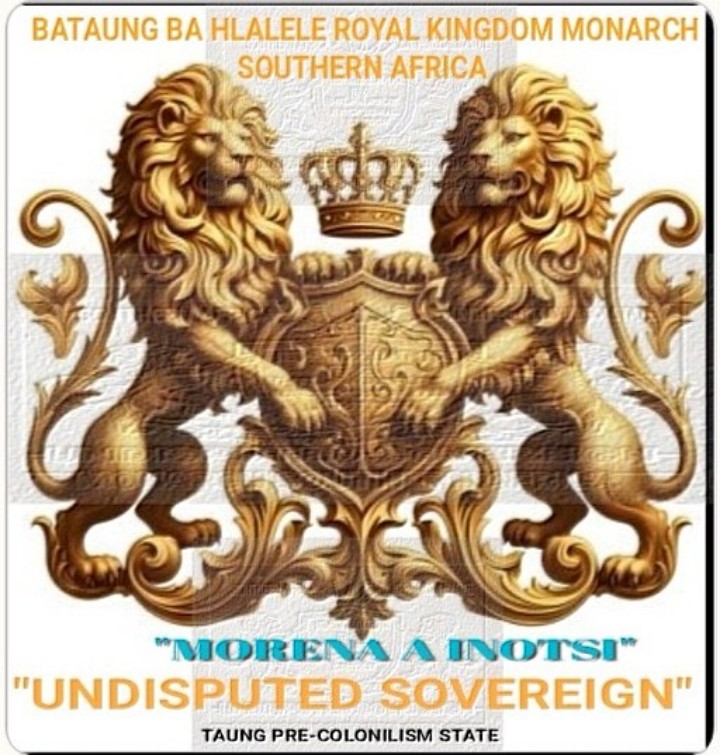
The Royal House of Hlalele, under the leadership of IM HRM King Khalo Jacob Hlalele, also known as Monarch Khalolabataung I, has intensified its call for the restoration of indigenous sovereignty, ancestral land rights, and the recognition of traditional law as an independent legal framework in Southern Africa. The movement positions itself as a continuation of the ancient Bataung Ba Hlalele nation, asserting that its authority predates colonial governments and modern constitutional systems.
#IndigenousSovereignty #BataungBaHlalele #AfricanRestoration
At the center of the House’s campaign is a challenge to South Africa’s current land restitution framework, particularly the 1913 cut-off date established by the Restitution of Land Rights Act. According to the Royal House, this legal limitation ignores earlier waves of dispossession suffered by indigenous sovereign communities long before the formal implementation of colonial land legislation.
King Khalo argues that the Bataung Ba Hlalele possess “allodial rights” to ancestral territories. In traditional and legal terms, allodial ownership refers to absolute and independent ownership of land that is not derived from the state. The House maintains that these rights are rooted in natural law and indigenous governance systems that existed long before colonial administrations imposed statutory legal systems across Southern Africa.
#LandRestitution #AllodialRights #NaturalLaw

The House of Hlalele further emphasizes that land restitution is not merely an economic issue. It is also a matter of identity restoration, dignity, spirituality, and the protection of ancestral burial sites. According to the Royal House, the restoration of sacred land is inseparable from the restoration of the cultural identity and historical continuity of the Bataung nation.
King Khalo’s advocacy extends into broader institutional and legal activism. The House consistently calls on the South African government to recognize indigenous law as an autonomous legal order capable of resolving disputes, maintaining social harmony, and governing traditional communities independently of colonial-era legal frameworks.
#TraditionalLeadership #AfricanIdentity #IndigenousLaw
The movement also critiques modern political structures, arguing that contemporary administrative systems often undermine traditional monarchies and indigenous authority. The House believes that colonial and missionary influences disrupted authentic African governance systems and weakened traditional institutions that historically governed communities through customary law and collective accountability.
In this context, the Royal House has also voiced criticism of foreign ecclesiastical influence, particularly the historical role of the papacy in shaping political and spiritual authority across Africa. Supporters of the movement argue that indigenous governance and African traditions should serve as the primary foundation for leadership, justice, and social organization.
#Decolonisation #AfricanTraditions #CulturalRestoration

The vision articulated by King Khalo J. Hlalele centers on the complete restoration of indigenous sovereignty. The House asserts that traditional authority is a birthright inherited through ancestral lineage and cannot be extinguished by colonial borders or modern constitutions. This vision seeks to move the Bataung Ba Hlalele nation beyond what the House describes as the “shadows” of external governance.
Among the movement’s core pillars is the principle of sovereign self-determination. The House maintains that indigenous communities possess an inherent right to govern themselves according to traditional law, customs, and cultural institutions. King Hlalele has repeatedly declared that indigenous law is the “ultimate law of life,” deeply embedded in ancestral traditions and rites.
#SelfDetermination #RoyalAuthority #BataungNation
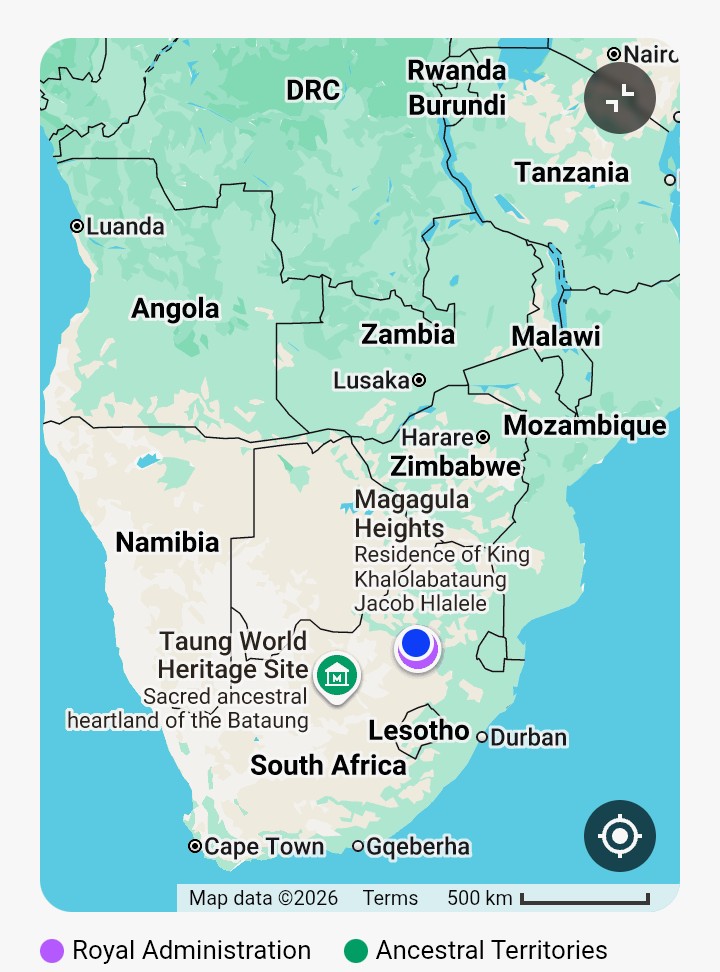
Another major focus is ancestral land restoration. The Bataung Ba Hlalele historical footprint spans several regions in Southern Africa, including parts of the Free State Province traditionally known as Matloangtloang, covering areas such as Heilbron, Bothaville, Kroonstad, and Ventersburg. The House also identifies Maboloka in the North West Province as a modern center of Bataung Ba Hlalele leadership and heritage.
Taung occupies a particularly significant place in the movement’s narrative. King Hlalele identifies Taung as the ancestral birthplace of the Bataung lineage and refers to it as the “Cradle of Humanity.” The House further emphasizes the historical rights of Bataung communities that remained within present-day South Africa following colonial border demarcations affecting Lesotho and surrounding territories.
#Taung #Matloangtloang #AncestralLand

The Royal House rejects classifications imposed during colonial and apartheid eras, including the homeland system established under apartheid policies. According to the House, these structures fragmented indigenous nations and attempted to erase authentic ancestral identities by reducing sovereign nations into administrative tribal authorities.
As part of its legal and political strategy, the House has issued declarations affirming the self-government and inalienable rights of indigenous people over ancestral territories. King Khalo identifies himself as the sovereign ruler of what he describes as a de facto indigenous state rooted in the ancient Bataung Dynasty.
#IndigenousRights #AfricanMonarchy #TraditionalGovernance
One of the movement’s most notable proposals is the “Lekgotla Peace Treaty and Coexistence Accord” between the House of Khosi Hlalele and the Republic of South Africa. The proposed agreement outlines several demands, including the cessation of state interference within specified Taung territories, recognition of the ANKH Decree and Totemic Law, restitution of ancestral land, repatriation of cultural artifacts and skeletal remains, and the coexistence of indigenous governance structures alongside the South African constitutional system.
The treaty proposal further calls for mutual non-aggression and recognition of parallel legal jurisdictions, with indigenous law taking precedence in matters concerning sacred land and ancestral lineage.
#Lekgotla #PeaceTreaty #CustomaryLaw

In advancing its modern restoration efforts, the Royal House has also embraced digital sovereignty initiatives. Through the use of Decentralised Identifier (DID) technology, the Kingdom seeks to establish independent systems of identity management and governance beyond post-colonial administrative databases. The House argues that such technological adaptation aligns with provisions within South Africa’s Traditional and Khoi-San Leadership Act, which encourages traditional institutions to modernize and remain relevant within constitutional democracy.
The House maintains that these efforts represent a continuation of historical statehood rather than the creation of a new political entity. According to its submission arguments, the Bataung Ba Hlalele historically operated as a centralized and sovereign nation governed through hereditary monarchy, senior councils, and structured traditional leadership systems.
#DigitalSovereignty #TraditionalLeadershipAct #AfricanInnovation
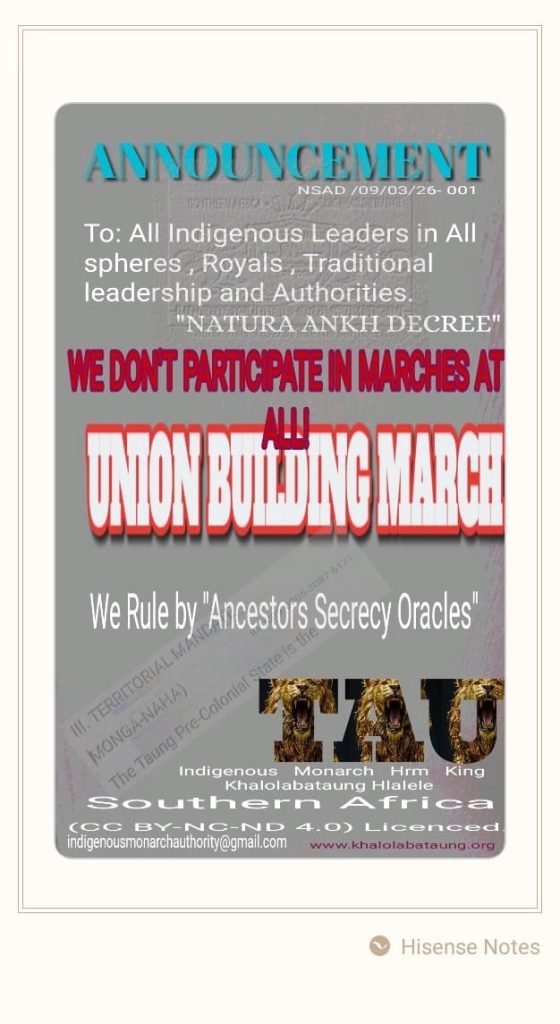
Supporters of the Royal House view the movement as part of a broader continental effort to reclaim indigenous identity, restore cultural pride, and challenge the lingering effects of colonialism. Critics, however, may question the constitutional, legal, and political implications of claims relating to parallel sovereignty and allodial land ownership within the framework of the modern South African state.
Nevertheless, the House of Hlalele continues to position itself as a leading voice in debates surrounding indigenous governance, land restitution, cultural restoration, and African self-determination in the 21st century.
#SouthAfrica #IndigenousGovernance #CulturalHeritage #AfricanSovereignty

That’s a really fascinating read. It’s incredible to see how communities are working to reclaim their heritage and legal traditions.
Perfect Peace 🙏